

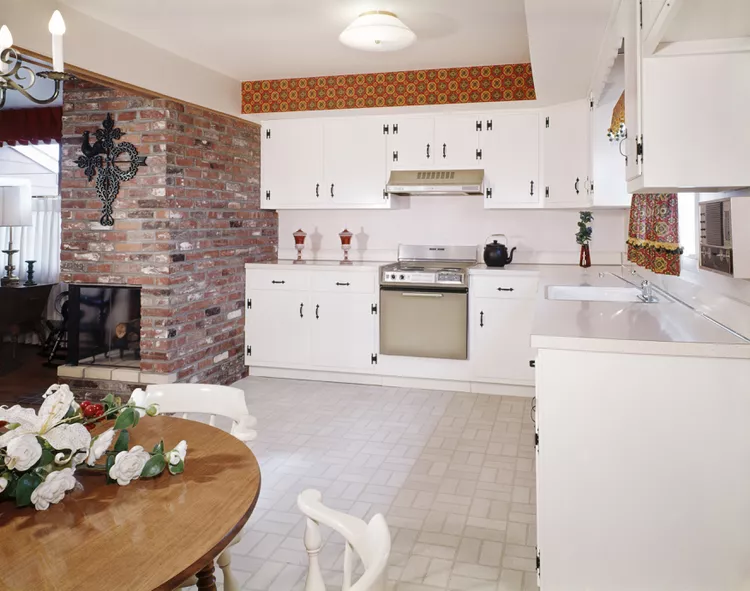
Remodeling a kitchen with historical roots is an exciting design challenge, but tackling a 1960s space requires navigating a unique piece of architectural history. The 1960s was a decade defined by radical, fast-moving cultural shifts. It opened under the clean-cut, formal post-war lens of the Eisenhower era and closed out amidst the counterculture explosion of Woodstock, Pop Art, and the Space Age.
Because of this cultural transition, 1960s kitchens have a fascinating split personality. An early-60s kitchen lean heavily into clean, understated mid-century modern lines, while a late-60s layout ventures into bold color palettes and futuristic synthetics.
When updating a 1960s kitchen for contemporary living, the goal isn't to build an exact time capsule. Instead, selective elements can be adapted to bring retro warmth, clean minimalism, and playful character into a modern space.
Architectural Layout: Floating Storage & Slab Cabinets
The 1960s marked the moment kitchens truly began breaking out of their traditional boundaries. Designers started tearing down full walls to connect the cooking zone with the dining and living spaces, giving birth to the open-concept home.
1. Ceiling-Hung Wall Cabinets
To maintain an open feeling while preserving precious storage, 1960s architects began hanging upper cabinets directly from the ceiling joists in the center of the room, using them as open-air room dividers above peninsulas.
-
The 1960s Reality: In homes with standard 8-foot ceilings, these cabinets hung directly from overhead beams. In higher vaulted spaces, custom iron pipe brackets or wood framing dropped down from above to suspend the upper cabinets aloft.
-
The Modern Adaptation: While fully enclosed ceiling-hung cabinets can feel visually heavy today, the concept translates beautifully into floating open shelves suspended by matte black iron or brass hardware above a kitchen island, keeping sightlines clear.
2. Flat Slab Cabinet Doors
If you want an instantly recognizable mid-century look, look no further than slab cabinet doors. Unlike traditional Shaker doors with recessed center panels, slab doors are completely flat, displaying an uninterrupted sheet of wood veneer or laminate.
-
Integrated Hardware: To keep lines as clean as possible, 1960s cabinets often omitted external knobs entirely. Instead, the top or bottom edges of the doors featured continuous grooved finger pulls carved directly into the wood.
-
Accent Materials: The latter half of the decade saw the introduction of semi-translucent accents, including textured faux bottle-glass plastic panels inserted into upper cabinet frames, often cast in muted ambers or olive greens.
Surfaces: Pop Art Laminates vs. Organic Brick
The material landscape of the 1960s was a battleground between futuristic, man-made synthetics and heavy, earth-bound organic textures. Embracing a 60s look means balancing these two opposing forces.
Material Profile Analysis
| Material Element | 1960s Design Application | Modern Renovation Upgrade |
| Solid Laminate Counters | High-energy, bold primary colors (sunflower yellow, orange) inspired by Andy Warhol and Pop Art. | Premium architectural laminates or solid-color quartz surfaces for a seamless look. |
| Exposed Brick Elements | Heavy structural brick half-walls, columns, and deep alcoves for wall ovens. | Real thin-brick veneers or restoring hidden original chimneys as accent walls. |
| Natural Wood Veneers | Muted, straight-grain walnut, birch, or oak panels that feel highly contemporary. | FSC-certified flat-grain walnut cabinets with low-sheen protective clear coats. |
| Knotty Pine Surfaces | Busy, high-contrast rustic pine used to evoke a traditional country cabin look. | Avoid or paint over; replace with clean, linear grain patterns to open up the room. |
The Synthetic Revolution: The 1960s saw the birth of groundbreaking composite surfaces, including the invention of DuPont Corian solid surfacing material. This paved the way for seamless, thermoformed countertops that could curve effortlessly up into the wall without dirt-catching seams.
Flooring & Dynamic Visual Patterns
Grounding the entire 1960s kitchen was a strong focus on graphic patterns underfoot and across the walls. As manufacturing technology improved, residential interiors grew increasingly playful and expressive.
1. The Rise of Resilient Sheet Vinyl
Alongside high-pressure laminates, the 1960s saw an explosion in the popularity of resilient sheet flooring, particularly wide 12-foot rolls of printed vinyl.
-
Why They Loved It: It was incredibly tough, waterproof, and simple to maintain. Because the material came in massive rolls, small and medium kitchens could be covered in a single piece, completely eliminating seams where moisture could warp the subfloor.
-
The Pattern Canvas: Vinyl allowed manufacturers to print any design imaginable. Kitchen floors showcased everything from simulated brick and faux marble grids to bold geometric hexagons and simulated wood planks.
-
The Modern Update: Rather than cheap sheet vinyl, modern renovations often use luxury vinyl plank (LVP) or high-durability porcelain tiles that offer authentic textures with vastly improved underfoot comfort.
2. High-Contrast Pop Graphics
If you want to lean into the energetic side of the era, look to the walls. Homeowners in the mid-to-late 60s rejected plain white drywall in favor of high-energy, graphic statement walls.
-
Geometric Motifs: Wallpaper and accent panels featured bold chevrons, overlapping triangles, playful starbursts, and retro boomerangs. Homeowners frequently used masking tape and paint rollers to create custom geometric patterns directly on their walls.
-
Space Age Accessories: These graphic walls were almost always paired with iconic period pieces. No 1960s kitchen was complete without a sculptural Sputnik ceiling light fixture or an atomic, starburst-shaped wall clock acting as a functional piece of art.
3. The Gold Medallion All-Electric Move
From a mechanical perspective, the 1960s pushed hard toward total modernization. Utility companies heavily promoted the "Gold Medallion Home" campaign, a standard that awarded a literal brass medallion to houses engineered to run entirely on electricity, pushing out traditional gas ranges in favor of smooth electric cooktops and built-in wall ovens.
When updating today, this electric legacy lives on through high-efficiency induction cooktops, which deliver precise, professional-grade performance while perfectly matching the flat, seamless minimalism that 1960s designers spent the entire decade trying to achieve.