

When you are looking at a row of shiny new faucets at the hardware store, they all seem pretty similar on the outside. But the real magic—and the headache, if it breaks—happens entirely on the inside.
Knowing what kind of valve mechanics are hidden beneath that chrome or matte black casing makes all the difference when you are upgrading your space, handling repairs, or picking a fixture that fits your lifestyle.
The Core Lineup: Faucet Mechanisms at a Glance
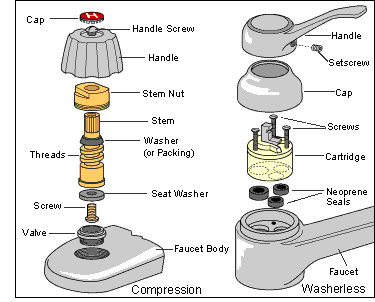
Faucets are broadly split into two categories: washerless (ball, disc, and cartridge) and compression (which rely on traditional rubber washers).
Here is how how how they stack up across reliability, operation, and maintenance:
| Faucet Type | Mechanism Style | Handle Style | Key Benefit | Main Drawback |
| Ball | Internal slotted ball | Single | Budget-friendly | Complex internals; prone to leaks |
| Ceramic Disc | Dual sliding discs | Single | Highly durable; effortless touch | Expensive upfront |
| Cartridge | Smooth sliding sleeve | Single or Double | Durable and easy to DIY fix | High replacement part costs |
| Compression | Compressed rubber washer | Double | Ultra-cheap parts | High maintenance; prone to frequent drips |
A Closer Look at the 4 Faucet Types
1. Ball Faucets
Commonly anchored in busy kitchens, these were the pioneers of washerless tech. You can spot them by a single lever hovering over a rounded, ball-shaped dome base. Inside, a plastic or metal ball with custom slots rotates against spring-loaded rubber seals to mix your hot and cold streams.
-
The Catch: While sleek and affordable, the high number of tiny internal parts makes them leak more frequently than other washerless models. When they do drip, tracking down the exact seal or spring that failed can be tricky.
2. Ceramic Disc Faucets
The absolute gold standard of modern plumbing. These feature a single lever sitting on a wider, cylindrical body. Inside a pressure-balanced chamber, two smooth, diamond-hard ceramic discs slide over one another to dictate water flow.
-
The Grip Advantage: They are incredibly sensitive to the touch. You barely need to nudge the handle to activate the water, making them the perfect choice for anyone managing arthritis or hand grip challenges. They are exceptionally long-lasting, though you will pay a premium price for them.
3. Cartridge Faucets
Cartridge models can look like single or double-handle systems. The defining trait here is tactile feel. Unlike older setups where you have to physically cinch the handle tight to stop a drip, a cartridge handle glides smoothly and shuts off completely with a crisp, effortless half-turn.
-
Maintenance Note: They are remarkably reliable and easy to swap out down the road. However, if your home has hard water, mineral deposits can work their way into the cartridge sleeves over time. Depending on the brand, high-end replacement cartridges can occasionally run north of $100.
4. Compression Washer Faucets
The granddaddy of indoor plumbing. Mostly found in historic homes or utility sinks, these are instantly recognizable by their dedicated, separate hot and cold handles that require a firm, clockwise twist to crush an internal rubber washer against a metal seat.
-
The Reality: They are the least expensive option on the market and dirt-cheap to repair. However, because rubber naturally degrades under constant friction and pressure, they are highly prone to dripping and require more frequent maintenance than modern designs.
How to Choose Your Next Faucet
Golden Rule of Swapping: You cannot change the internal valve mechanism within an existing faucet shell. However, you can completely replace an entire old fixture with a totally different mechanism style—provided the new unit covers the existing holes in your sink deck. Single-handle models with wide baseplates are great for hiding old three-hole cutouts.
To nail down the right choice for your home, match your situation to these profiles:
-
For Accessibility and Longevity: Invest in a Ceramic Disc faucet. The effortless lever operation is a lifesaver for joint pain, and the tech outlasts the competition.
-
For the DIY-Minded Homeowner: Go with a Cartridge faucet. The swap-out process is incredibly user-friendly when maintenance is eventually required.
-
For a Budget Kitchen Refresh: Choose a classic Ball faucet. It gives you the clean aesthetic of a single-handle setup without breaking the bank.
-
For Historical Authenticity or Utility Spaces: Stick with a Compression faucet. It preserves the vintage aesthetic of a classic home, and the rubber washers can be replaced for pocket change.